
Editorial
A Word a Day: The Small Habit That Builds a Big Vocabulary
One word a day is 365 words a year — and each new word makes the next one easier. The compound-interest habit that builds a big vocabulary quietly.
By Ananya Deshpande (R&D Team, Lingobotix) | November 2026
Ask a wealthy person how fortunes are built, and the honest ones rarely mention luck. They mention small deposits, made regularly, over a long time — money earning interest on interest until the pile surprises even its owner. Vocabulary grows by exactly the same law. One word a day sounds too small to matter. In truth, it is one of the most powerful habits an English learner can own.
Small Deposits, Large Interest
Do the simple arithmetic. One word a day is seven words a week, thirty words a month, three hundred and sixty-five words a year. But words are not coins sitting idle in a box. Every word you learn makes the next word easier: it appears in your reading, explains its neighbours, and connects to a family of relatives — act, action, active, activity — so one deposit often buys four words.
Compare this with the opposite habit: fifty words crammed before an examination, and forgotten by the following month. Cramming is carrying water in a basket. The daily word is digging a well. A year later, the crammer starts from zero again, while the daily learner opens her notebook and finds a small fortune.
Choose Words That Work
Not all words pay equal interest. Spend your daily deposit on words that earn: words you meet often in books and conversation, words your own life needs. A student should own "borrow", "deadline" and "confused" before she owns rare jewels she will use once a year.
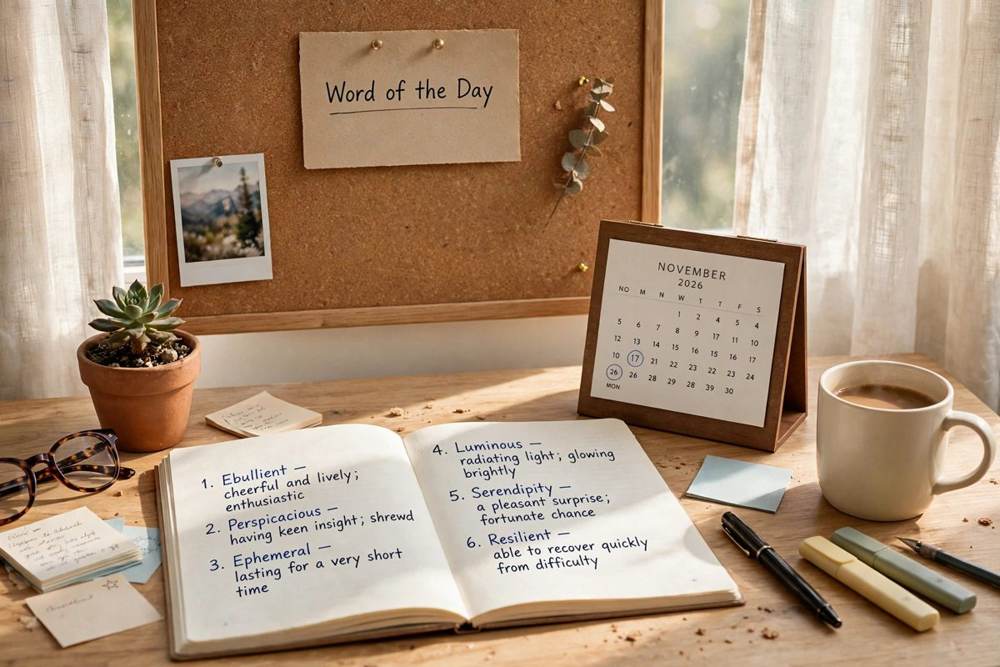
The best source of daily words is your own reading and listening. A word you met inside a story arrives with its meaning half-explained and its memory half-built. Keep a small notebook — paper or phone — with one page per word: the word, its meaning in simple English, and one sentence from your own life. Not the dictionary's sentence. Yours. "I borrowed my brother's bicycle" will outlive any example a book can print.
Make the Word Yours
A word is not learned when you understand it. It is learned when you use it. So the daily ritual has a final step: use the new word three times before the day ends — once in writing, twice in speech, however small the stage. Tell your friend about the "traffic". Describe the "delicious" lunch. Announce that you are "exhausted". Each use drives the word one layer deeper, from the notebook into the tongue.
Review gently on Sundays: flip through the week's seven words and smile at how many you already recognise in the wild. Recognition is interest being paid.
One word a day will never trend on social media. It is too quiet, too ordinary, too slow for applause. But give it a year, and then try to count what it has built: hundreds of words, thousands of sentences understood, and a learner who no longer fears the dictionary — because she has been writing her own, one word at a time.