
Editorial
Shadowing: Borrow a Voice Until Yours Arrives
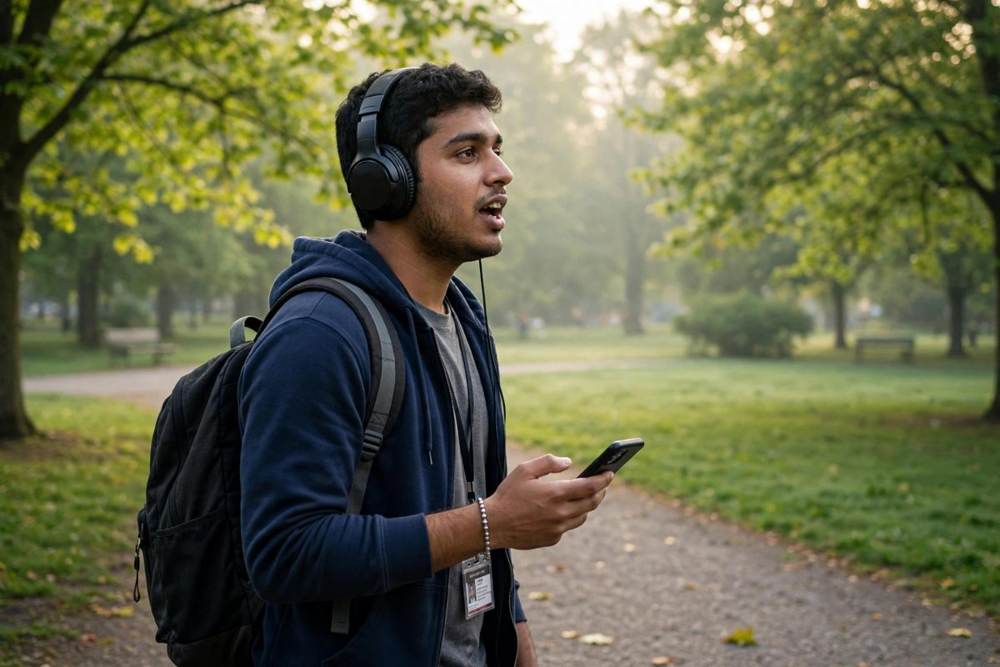
Copy a great voice until your own voice grows stronger. This article explains shadowing in easy steps you can practise on your morning walk.
By Rohan Mehta (R&D Team, Lingobotix) | November 2026
Actors in Mumbai learn film dialogues by repeating them until the words feel like their own. Singers copy great singers for years before their own style appears. In language learning, there is a method that works on the same simple principle. It is called shadowing, and it may be the most powerful speaking practice you have never tried.
Shadowing means listening to a native or fluent speaker and speaking along with them, at the same time, like a shadow following a person. You do not wait for the sentence to finish. You walk with it, matching its speed, its music, and its rhythm, step by step.
1. Why Copying Works So Well
When you read silently, only your eyes are learning. When you shadow, your ears, mouth, tongue, and breath all learn together. Your mouth discovers movements it has never made. Your ear begins to catch the rise and fall of English sentences, the way the voice climbs for a question and settles for an answer.
Shadowing also removes the hardest part of speaking: thinking of what to say. The words are given to you. Your only job is to deliver them well. This frees your full attention for pronunciation and rhythm, the two things that make speech sound natural and easy to understand. Over weeks, something lovely happens. Phrases you have shadowed fifty times begin to appear in your own conversations, uninvited and perfectly dressed.
2. How to Shadow, Step by Step
Choose a short audio or video clip, one or two minutes long, with clear speech and subtitles. A scene from a series, a speech, an interview, or your course audio will do. First, just listen twice and understand the meaning. Never shadow words you do not understand; a parrot can copy sounds, but you are building language.
Next, read the text aloud slowly by yourself. Then play the audio and speak along, a fraction of a second behind the speaker, like an echo that refuses to be late. Keep your voice strong, not a whisper. Repeat the same clip daily for a week. It will feel difficult on day one and strangely easy by day five. Walk while you shadow, if you can. Movement loosens the body, and a loose body speaks more freely.
3. Borrow Boldly, Speak Freely
Some students feel shy about copying, as if it were cheating. It is not. Every musician copies masters. Every cricketer copies a great player's shots in the nets. Borrowing a voice for practice is how every performer in history has built one of their own.
So borrow a voice you admire. Walk with it every morning for ten minutes. One day, in the middle of an ordinary conversation, you will hear your own English and pause in surprise. It will sound smoother, quicker, more alive. The borrowed voice will have quietly become yours.