
Editorial
The World Is Your Classroom
English is painted on every shop board and announced at every station. Open your eyes to the free classroom waiting all around your town.
By Kavita Sharma (R&D Team, Lingobotix) | November 2026
Most students believe English lives inside a classroom, between the covers of a textbook, during forty minutes of the school day. But step outside the school gate and look around with fresh eyes. English is everywhere. It is painted on shop boards, printed on bus tickets, glowing on phone screens, and announced at railway stations. The whole world has quietly become a classroom. It is only waiting for students who notice.
This is wonderful news, especially for learners who feel they have no time or money for extra study. The lessons outside are free, they run all day, and they never take attendance. You simply have to start reading the world the way you read a book.
1. Read Every Sign You Pass
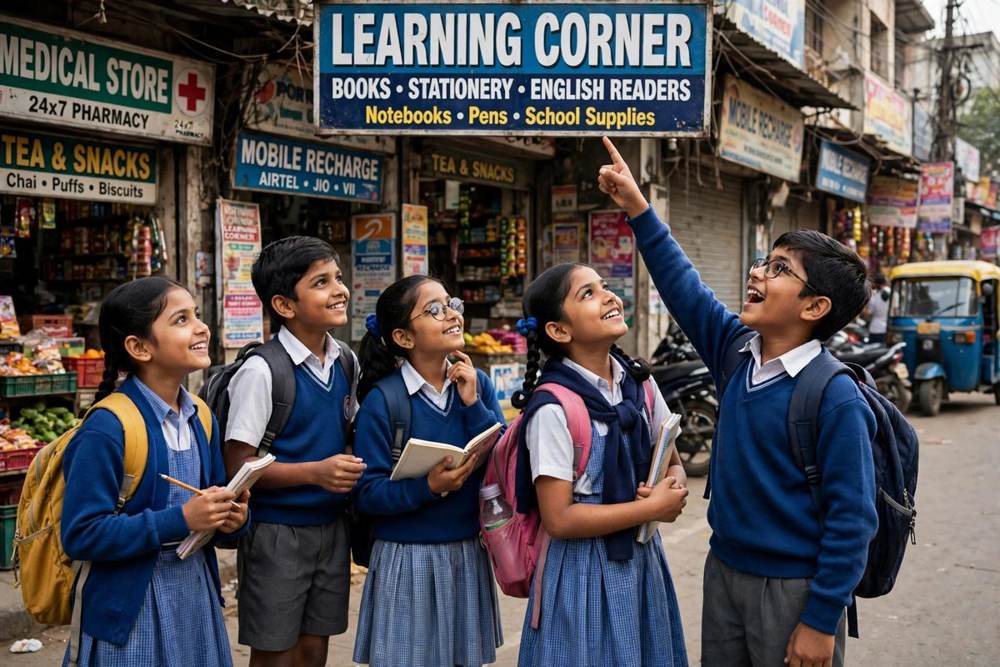
Begin with signboards. On one short walk in any Indian town, you will pass a hundred English lessons: Hair Cutting Saloon, Fresh Juice Corner, Books and Stationery, No Parking, Push, Pull, Exit, Open, Closed. Read each one aloud or in your mind. Ask yourself what it means and whether you could use its words in a sentence of your own.
Advertisements are small, free lessons too. Companies spend crores choosing a few powerful English words. Steal their craft. When a poster says "Taste the Magic," ask why those three words work. Note one good phrase a day in your notebook. Within a month, you will own a small treasure of real, living English that no examination guide could give you.
2. Listen to the World Talking
The world also speaks English aloud, if you train your ear to notice. Station announcements repeat the same patterns daily: "Attention please, train number..." Flight and metro announcements, customer care voices, and instructions in lifts all use simple, clear, repeated English. Repetition is the mother of memory, and the world repeats itself generously.
Even overheard conversations teach. In a café or a train, listen respectfully to how people greet, order, thank, and say goodbye in English. Notice the small polite words that oil every exchange: please, excuse me, thank you, sorry, could you. These tiny phrases are the true currency of spoken English, and the world hands them out free of charge all day long.
3. Carry a Notebook, Harvest the Day
Make the world your classroom in one practical way: carry a small notebook, or use your phone, as a harvest basket. Every day, collect three things: one new word, one useful phrase, and one sentence you heard or read and liked. In the evening, read your harvest once. That is all. Three a day becomes ninety a month, and ninety a month becomes a vocabulary that grew without a single hour of forced study.
The classroom has walls, but learning does not. From tomorrow morning, walk to school or work a little more slowly, with your eyes open and your ears awake. English is written all over your own town, calling your name. All you have to do is answer.