
Editorial
The Sounds That Need a Second Look
A kind guide to the English sounds that feel tricky for Indian learners, with a gentle five-minute daily practice for a clearer voice.
By Vikram Sethi (R&D Team, Lingobotix) | November 2026
Every learner of English meets a few sounds that refuse to sit comfortably in the mouth. The words look simple on paper, yet when you say them, something feels slightly wrong. A friend may smile, a teacher may repeat the word slowly, and you realise your tongue went to a familiar place instead of a new one. This is not a lack of talent. It is simply the habit of your first language guiding your mouth.
Our mother tongue teaches us, from childhood, which sounds matter and which movements feel natural. Hindi, Punjabi, Bengali, Tamil, and other Indian languages each have their own beautiful sound systems. English uses some sounds in a different way, and a few sounds may be new altogether. When we notice this difference with kindness, learning becomes much easier.
1. Why Some Sounds Feel Difficult
Think of the mouth as a musical instrument. If you have played one instrument for many years, your fingers know its habits. Learning a second instrument does not erase the first skill, but it asks for new positions and new practice. In the same way, your tongue, lips, and jaw have practised your home language thousands of times every day.
That is why an English sound can feel strange at first. The sound in "very" may come out like "wery" because our languages often use a softer sound. The beginning of "think" may become "tink" or "sink" because the tongue does not naturally rest between the teeth. These are common, honest steps in learning, not mistakes to be ashamed of.
Understanding this takes away fear. You are not speaking badly. You are carrying an old habit into a new language, and habits can be gently retrained with time and attention.
2. The Sounds to Watch Closely
A few English sounds deserve a second look for many Indian learners. The "v" and "w" sounds are close cousins but not twins. In "vest", the top teeth lightly touch the lower lip. In "west", the lips become round, as if you are about to whistle. Practising pairs like "vine" and "wine" helps the mouth feel the difference.
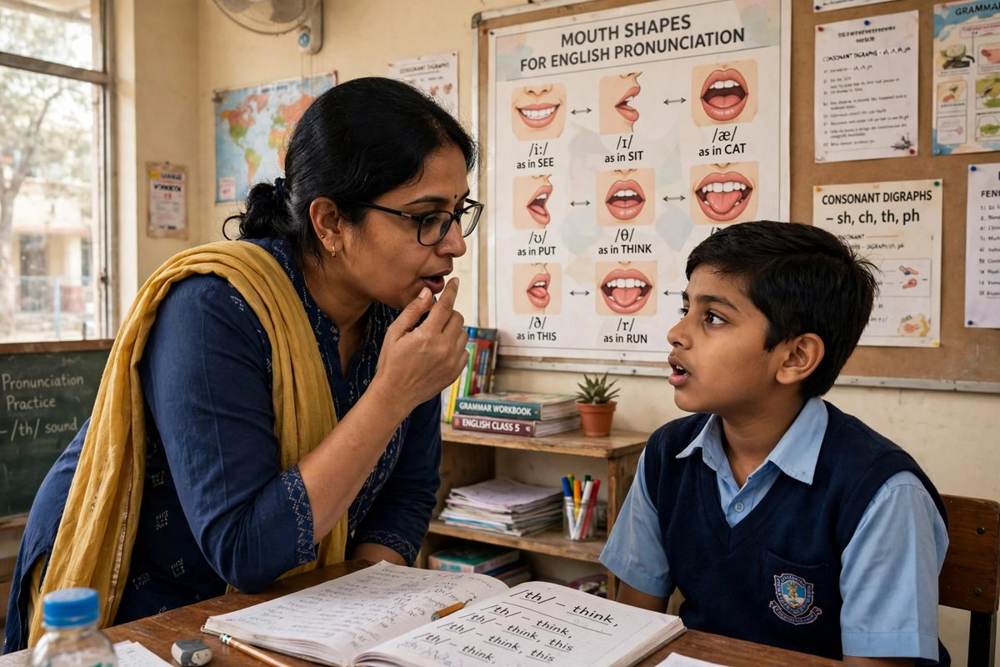
The "th" sounds also need care. In "this" and "think", the tongue peeks out slightly between the teeth and air flows through. It may feel odd in the beginning, almost playful, but children do it naturally and adults can learn it too.
Pay attention also to the ending sounds of words. English often needs the final sound to be clear — "cap" is not "ca", and "bus" is not "bu". In our daily speech at home we sometimes soften endings, but in English those small endings carry meaning and grammar. Listening for them will improve both speaking and understanding.
3. A Gentle Daily Practice
You do not need an hour a day. Five careful minutes can do more than thirty careless minutes. Choose two or three words with the sound you are learning. Say them slowly in front of a mirror. Watch your lips and tongue. Then say them in a short sentence, the way you would use them in real life.
Record yourself on your phone once a week. Listening to your own voice is a powerful teacher. You will hear progress that you cannot feel while speaking. Ask a teacher or a friend to listen too, not to judge you, but to guide you like a coach.
Most of all, be patient with your mouth. It has served you faithfully in your own language for years. Give it time, give it practice, and one day these new sounds will stop feeling foreign. They will simply become another way you can be understood, clearly and confidently, by the world.