
Editorial
Learn Phrases, Not Just Words
English travels in phrases, not lonely words. Collect ready-made chunks of language and watch your sentences come faster, smoother and more natural.
By Vikram Sethi (R&D Team, Lingobotix) | November 2026
A student once showed me his English notebook with great pride. Page after page was filled with words and meanings: "brave — courageous," "begin — start," "happy — joyful." He had collected hundreds of words, the way one collects stamps. Then I asked him to make a sentence about his school day. He paused, searched his rich collection, and slowly produced a sentence that sounded like a puzzle put together with great effort.
His problem is very common, and it is not a lack of words. It is the way the words were learned. English does not travel in single words. It travels in phrases — small groups of words that live together, like families. When we learn the families instead of the lonely words, speaking becomes faster, smoother, and far more natural.
1. How English Really Travels
Listen carefully to fluent speakers and you will notice something interesting. They are not building every sentence word by word, like a mason laying single bricks. They are using ready-made pieces: "as soon as possible," "on the other hand," "I am looking forward to it," "it depends on the situation." These chunks come out whole, without thinking.
This is how children learn too. A child does not learn "good" and "morning" separately and then join them with grammar. The child learns "Good morning" as one warm piece of language, and uses it perfectly before knowing any rules at all.
When you learn phrases, your English begins to sound like English — not like your mother tongue wearing English words. The natural word order, the small joining words, and the correct grammar all arrive together, hidden inside the phrase.
2. Phrases Worth Collecting
Begin with the phrases of daily life, because you will use them every day. For requests: "Could you please...?" and "Would it be possible to...?" For opinions: "In my opinion..." and "As far as I know..." For time: "in the morning," "at the moment," "from time to time." For the classroom and office: "I have a doubt about...," "Let me explain," and "Thank you for your support."
Notice how each phrase carries a small piece of grammar inside it. "I am looking forward to meeting you" teaches a difficult pattern without any rule book. Learn the phrase, use it ten times, and the pattern quietly becomes yours forever.
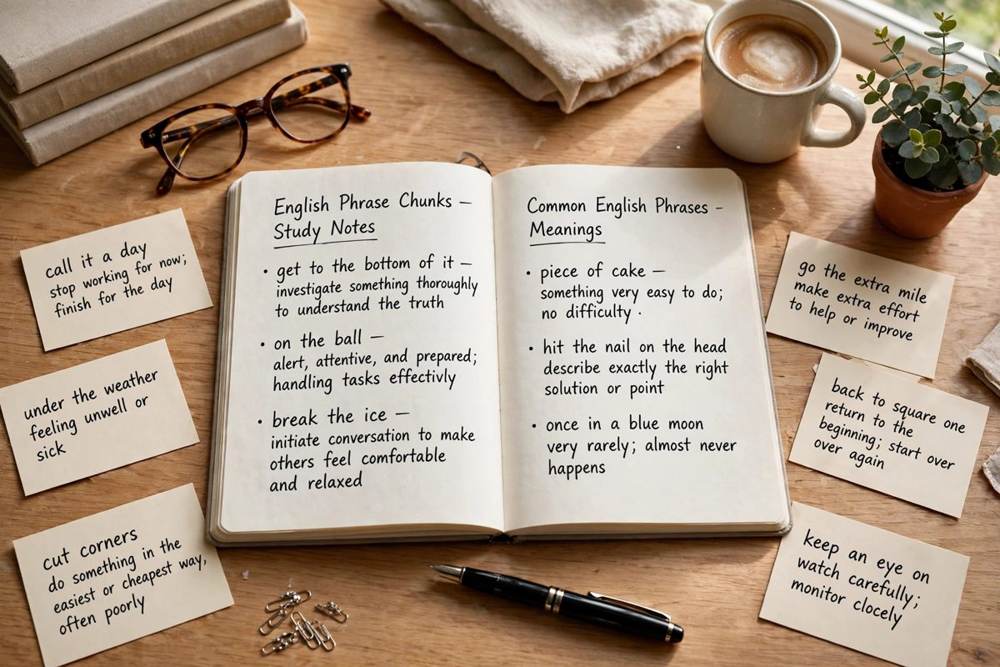
Keep a phrase notebook, separate from any word list. Write the full phrase, write its meaning in your own simple words, and write one sentence from your own life beneath it. A phrase tied to your life is a phrase you will never forget.
3. Use Them Until They Are Yours
A phrase is not learned when you understand it. It is learned when it comes out of your mouth at the right moment, without searching. For that, you must use each new phrase in real speaking and writing, again and again, in the first few days after meeting it.
Set yourself a friendly challenge: choose three phrases every morning and use all three before night — in class, at work, in a message to a friend. Some attempts will feel clumsy. That clumsiness is the sound of learning happening.
Words are the bricks of a language, but phrases are its ready rooms — furnished, comfortable, and fit to live in. Collect words if you enjoy them, but build your English from phrases. Your sentences will come faster, your listeners will understand you better, and one day you will realise you are no longer translating in your head. You are simply speaking.