Editorial
Storytelling: The Oldest English Lesson
Long before schools existed, stories were teaching the world. See why a bedtime story in English may be the most natural and joyful English lesson of all.
By Arjun Malhotra (R&D Team, Lingobotix) | November 2026
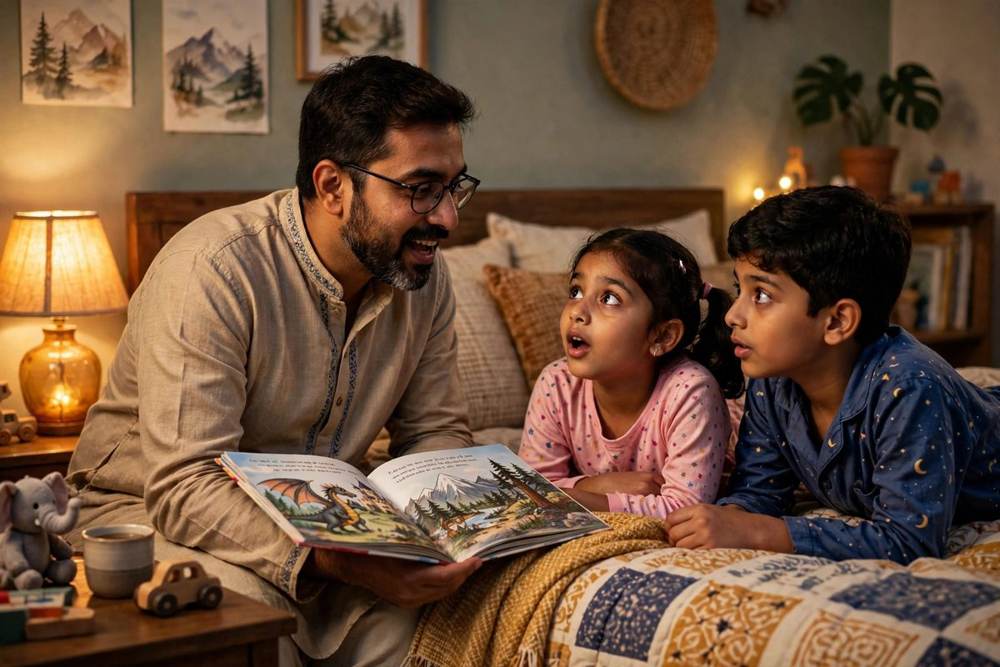
Long before there were schools, there were stories. A grandmother by a winter fire, a father on a long train journey, a mother beside a sleepy child — human beings have taught everything through stories: courage, kindness, cleverness, and language itself. The oldest classroom in the world has no walls. It has a voice, a listener, and a tale.
1. Stories Came Before Books
Every culture on earth began its teaching with storytelling. Our own land is rich with such tales — grandmothers have carried whole libraries in their memory for thousands of years, passing wisdom from one generation to the next without a single printed page.
Notice something wonderful: no child ever asks for a grammar lesson at bedtime. They ask for a story. And while they listen for the dragon or the clever rabbit, language slips quietly into their minds — new words, new sentence shapes, the music of speech — all without effort and without fear.
This is why storytelling remains the oldest and most natural English lesson. When the story is in English, the language enters through the door of delight.
2. Why Stories Teach So Well
Our brains are built for stories. A list of ten words is forgotten by Friday, but a word inside a story — the giant's thundering "Fee, fi, fo, fum!" — is remembered for years. Emotion is the glue of memory, and stories are made of emotion: surprise, laughter, worry and relief.
Stories also teach the order of language. First this happened, then that, and finally the ending. A child who hears many stories begins to speak in this natural order, building longer and clearer sentences without knowing any rule.
And stories give us ready-made English. The phrases a child hears again and again — "Once upon a time," "What happened next?" "And they lived happily ever after" — become building blocks she will use in her own speaking and writing for the rest of her life.
3. Become the Storyteller at Home
You do not need to be a teacher to give this gift. You need ten minutes and a willing voice. Read one short English story aloud at bedtime, or tell a known tale — a Panchatantra story, a folk tale from your own state — slowly, in simple English.
Do not stop at every new word to explain it. Let the story flow; children understand far more from the flow than we think. If your child asks a question, answer it warmly and continue. The next night, invite the child to retell the story in her own words — first in your home language if needed, then, little by little, in English.
A family that tells stories is quietly building a library inside the child's mind. Years later, when that child speaks English with ease, she may not remember the lessons. She will remember the stories — and the voice that told them.