
Editorial
The Library Card: Your Free English University
For the price of a small deposit, a library card opens thousands of English books to any student. Find out how to begin your library life and read your way to strong English.
By Sneha Kulkarni (R&D Team, Lingobotix) | November 2026
In almost every Indian town there stands a quiet building that most people walk past without a glance. Inside it are thousands of books — stories, histories, science, poetry, newspapers in many languages — and nearly all of it is free. It is the public library, and its small plastic card may be the most powerful card a student can own.
1. A Small Card, A Big Door
A library card costs very little — in many towns, only a small deposit that comes back to you. Yet what it opens is enormous. With that one card, a student from any family, rich or poor, can borrow the same books that students in big city schools enjoy.
Think of what this means for English. English books are expensive; a single good novel can cost more than a family's weekly vegetables. But the library removes the price completely. The only admission fee is curiosity.
Great readers throughout history have been library children — boys and girls who could not buy books, so they borrowed them, week after week, until the borrowed words became their own strength.
2. Everything Inside Is Free
Walk into a library with English in mind and you will find a full university waiting. There are graded readers for beginners, storybooks for children, novels for growing readers, and biographies of great lives for those ready for more. There are English newspapers and magazines that teach the living language of today.
There is also a person who is a treasure herself: the librarian. Tell her your level honestly — "I am beginning English stories" — and she will walk you to the right shelf like a guide who knows every street of a beloved city. Never feel shy to ask. Guiding readers is the joy of her work.
And there is the reading room itself: a calm, silent hall where everyone around you is reading. Such company makes reading easy. Habits grow best where they are surrounded by the same habit.
3. How to Begin Your Library Life
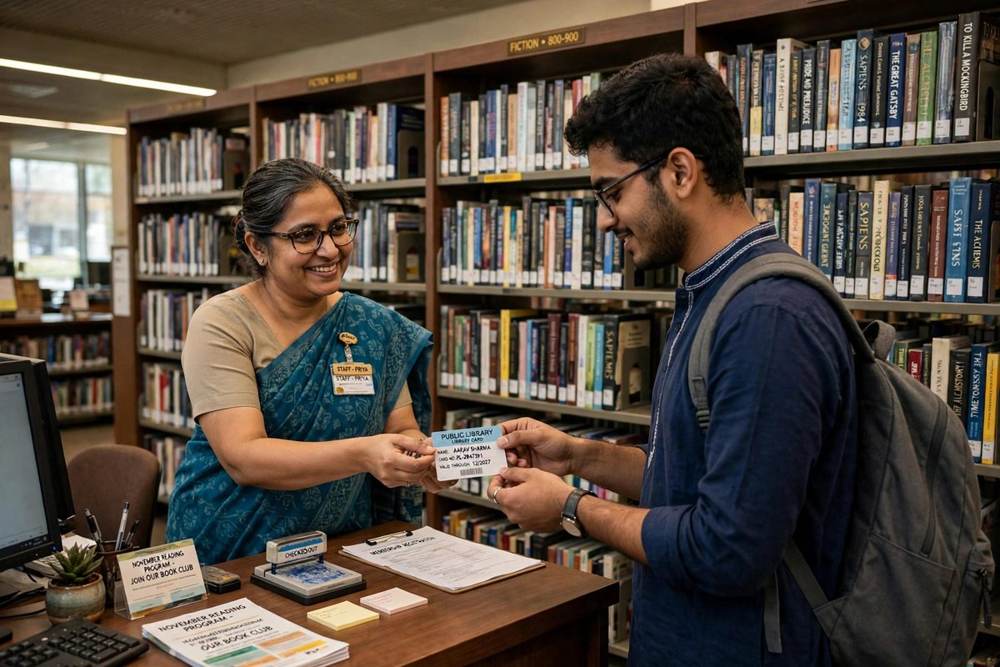
Begin this week. Find the public library nearest your home — ask at school, or search on your phone. Carry a photograph and a small deposit, fill the form, and hold your card like the key it truly is.
Make a fixed library day — every Sunday morning, perhaps — and protect it like an appointment with a dear friend. Borrow only two books at a time; finish them with love rather than hoarding ten with guilt. Keep a small diary of what you read: the title, three new words, and one line you loved.
Within a year, that diary will hold fifty books. No course in the world can give a student fifty books of English, freely chosen and joyfully read. The library can — and it has been waiting for you all along.