
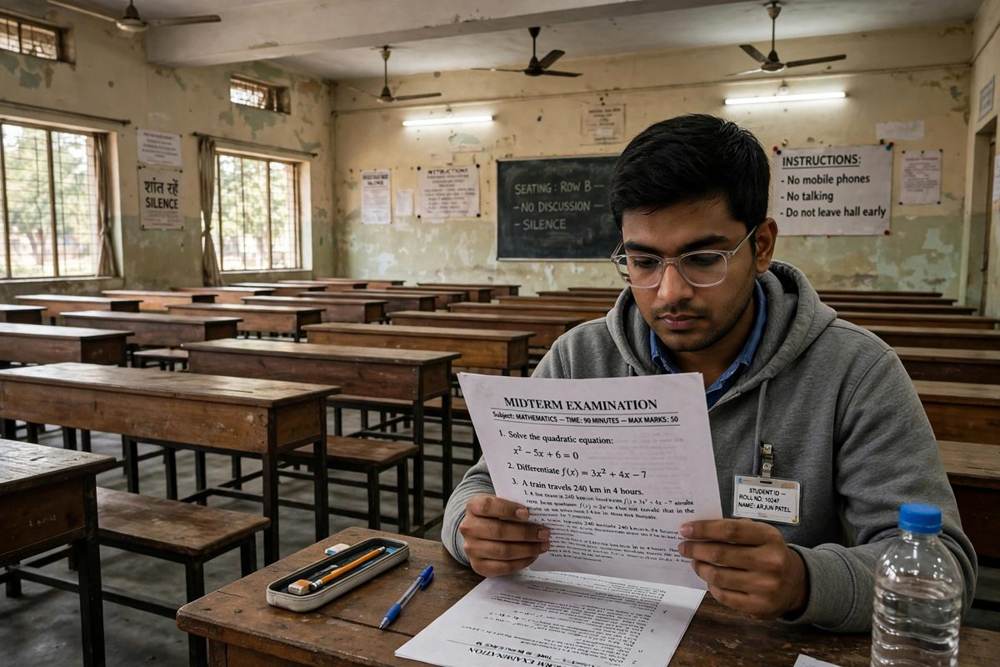
Editorial
Reading the Question Right: Exams in English
Many exam marks are lost before the first line is written — in the hurried reading of the question. Learn to read slowly, spot the command words, and walk into the hall with a calm plan.
By Vikram Sethi (R&D Team, Lingobotix) | November 2026
Every teacher has seen this sad scene. A student leaves the exam hall, hears a friend discuss the paper, and slaps his forehead: "I knew that answer! But I wrote about the other chapter." He did not lose those marks because his English was weak or his studies were poor. He lost them in the first minute — because he did not read the question right.
1. Most Marks Are Lost Before Writing
We imagine exams are lost during writing. Teachers who check copies know the truth: many marks are lost before the first line is written, in the hurried reading of the question. The student sees two familiar words, his mind rushes to a prepared answer, and he writes beautifully — on the wrong topic.
This happens most in English papers, where questions are longer and the language itself must be understood before the answer can begin. A science answer written in simple words may still score; an English answer to a misread question scores nothing, however fine the handwriting.
The good news is this: reading a question carefully is a skill, and like every skill, it can be practised and mastered by any student.
2. Read Slowly, Read Twice
Make this your rule in every exam: read each question twice — once for the story, once for the instruction. In the first reading, ask yourself, "What is this question about?" In the second reading, hunt for the command word, the word that tells you what to do.
Command words are small but mighty. "Describe" asks for a picture in words. "Compare" asks for two sides, point by point. "Explain" asks for reasons. "Give your opinion" invites your own view, supported by examples. Underline these words on the question paper, and underline the topic words too. Your pen, moving slowly for ten seconds, can save you ten marks.
Also watch for quiet words that change everything: not, only, main, first, two. "Give two reasons" is not the same as "Give reasons." The examiner hides no traps; the words are all printed clearly. They reward only those who slow down enough to see them.
3. A Calm Plan for the Exam Hall
In the first five minutes, read the whole paper without writing a word. Mark the questions you know best. Begin with those, and let early success calm your mind — a calm mind reads far better than a frightened one.
Give each question its fair share of time, and keep the last ten minutes only for re-reading your answers. You will be surprised how many small mistakes your own eyes can catch when they return as a reader, not a writer.
Above all, remember: the question paper is not your enemy. It is a letter from the examiner saying, "Show me what you know." Read it slowly, read it fully — and then show them everything you know.