
Editorial
The Five-Minute Rule: Tiny Practice, Daily
No time to practise? Five honest minutes every day beats two grand hours once a month. This article shows what fits inside five minutes and how to never break the chain.
By Vikram Sethi (R&D Team, Lingobotix) | November 2026
"I have no time to practise English." Teachers hear this sentence every day, from students with heavy school bags and from parents with heavy workdays. And it is honestly spoken — modern life is busy. But it hides a mistake about how practice works.
We imagine practice must be long to be useful: one full hour at a desk, books open, silence all around. Since such an hour rarely comes, practice rarely happens. The five-minute rule offers a kinder, cleverer path: practise for only five minutes — but practise every single day.
1. Five Minutes Is Small Enough to Keep
Five minutes asks for almost nothing. It fits before breakfast, inside a bus ride, while the dal is cooking, or in the pause before sleep. Because it is so small, your mind does not argue with it. Nobody postpones five minutes.
This is the deep secret of habits. A habit does not need to be big; it needs to be unbroken. Five minutes daily for a month gives you thirty practice sessions — thirty times your brain touched English, thirty small deposits in the bank of fluency.
Compare that with the grand plan of studying two hours every Sunday, which survives for two Sundays and then quietly dies. The small daily habit defeats the big occasional effort, every single time.
2. What Fits in Five Minutes
You may be surprised how much learning fits inside five honest minutes. Read one page of an English book aloud. Learn three new words and make one sentence with each. Listen to one short English audio and repeat its lines like an actor.
Speak about your day for five minutes — what you did, what you ate, what you plan tomorrow. Describe the room around you. Translate the signboards you saw on the road. Narrate the cooking in your kitchen: "Now I am adding the onions."
Keep a small list of such five-minute tasks ready on paper or in your phone. The moment a free gap appears in your day, you will not waste it deciding what to do. Pick a task, set the timer, and begin.
3. Never Miss Twice
Life will interrupt. A guest will arrive, an exam will press, a day will simply run away. One missed day is an accident, and accidents are allowed. The rule is only this: never miss twice.
Two missed days begin to feel like a new habit — the habit of not practising. So after a missed day, make the next day's five minutes sacred. Do them first, before anything else. Even half-asleep, even standing in the kitchen, do them.
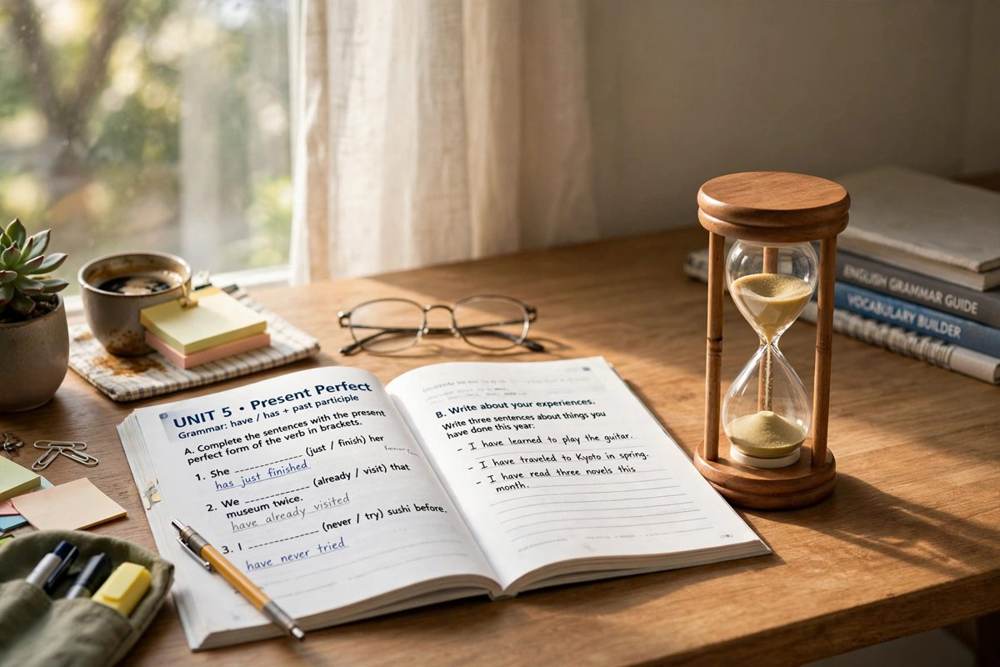
Use a small timer, an hourglass, or the clock on your phone, and let it watch your five minutes like a friendly referee. When it rings, close the book with a feeling of victory. You kept your promise to yourself today. Do this for a season, and one morning you will notice something wonderful: English no longer waits for your free time. It has moved into your everyday life — five minutes at a time.