
Editorial
Keep a Learning Journal: Watch Yourself Improve
A simple notebook can prove what your memory doubts — that you are improving. Learn what to write each day and how your own handwriting becomes your strongest motivation.
By Ananya Deshpande (R&D Team, Lingobotix) | November 2026
Every January, gyms fill with people full of hope. By March, most have quietly disappeared. What went wrong? Ask the few who stayed, and many will show you something simple: a notebook, or a chart on the wall, where every day of effort is marked. They could see their progress — and what we can see, we protect.
English learners face the same invisible problem. You practise for weeks, yet improvement hides. It grows slowly, inside, like a plant under the soil. A learning journal brings that hidden growth into the light.
1. Progress You Can See
A learning journal is a simple notebook where you record your English journey, a few lines each day. It is not a school exercise and nobody will check it or mark it. It belongs to you alone.
Its power is honesty. Memory lies to us kindly: on a bad day, we feel we have learned nothing in months. The journal answers with facts. Here, in your own handwriting, are the words you knew in October, the sentence you could not build in November, the page you read easily in December. Feelings may doubt, but the written record stands firm.
Students who keep journals rarely quit. They have proof that effort is turning into ability — and proof is the strongest motivation in the world.
2. What to Write Each Day
Keep each entry small, or the habit will die. Write the date. Then note three things: the new words you learned, with one line of meaning; one English sentence you spoke or wrote today that pleased you; and one mistake you noticed, written correctly beside it.
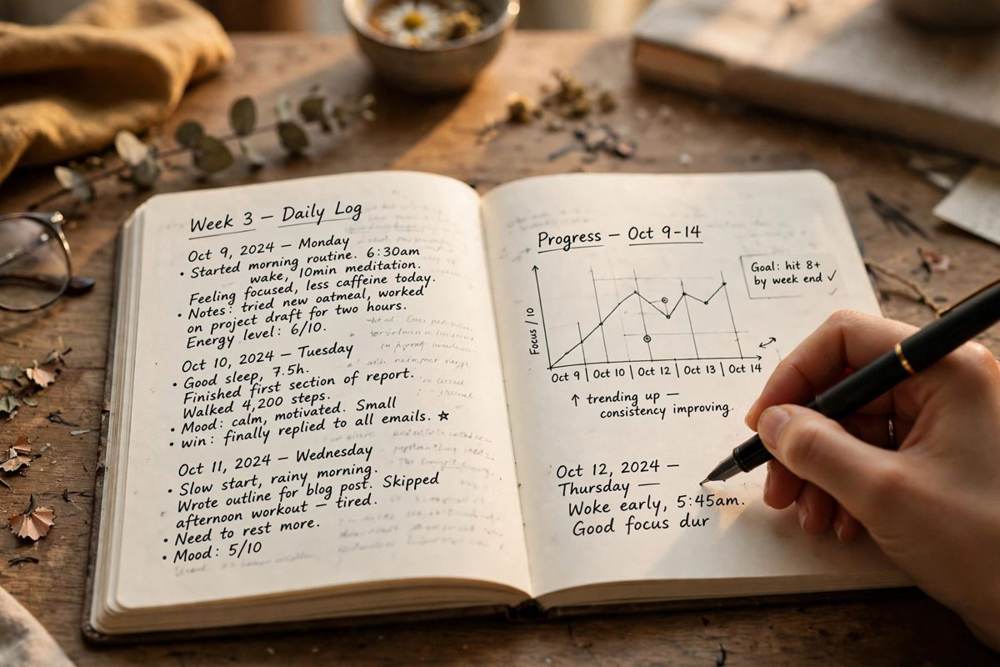
Once a week, add a small progress line. How many pages did you read? How many minutes did you listen? You can even draw a tiny graph, climbing week by week — children love this, and so, secretly, do adults.
Write your entries in simple English as much as you can. In the beginning, mix freely with your own language where English is too hard. Over the months, watch the mixture change by itself: more English, less support, longer sentences. The journal becomes a mirror that shows your language growing up.
3. Read Your Own Story
The sweetest use of a journal comes later. Once a month, sit with a cup of tea and read your old entries. You will smile at sentences that once felt so difficult. You will meet words you had forgotten you learned. You will see, page by page, a person becoming fluent.
On the days when English feels hopeless — and those days visit every learner — open the journal instead of arguing with your mood. Let your past self encourage your present self.
So buy a plain notebook this week. Write the first date at the top of the first page, and below it, one honest line: "Today I began." A year from now, that line will be the first page of a story you will be proud to read — the story of how you learned English, written by the only person who truly knows how hard, and how worthwhile, it was.