
Editorial
Numbers, Dates and Money: The English Nobody Teaches
Prices, dates, bills and change - the English of daily life is rarely taught in class. Here is how to master the small number-words that matter every single day.
By Kavita Sharma (R&D Team, Lingobotix) | November 2026
Ask a student to read a paragraph in English and she may manage well. Then ask her to say today's date, read a price aloud, or explain a mobile recharge plan — and watch the silence. Somehow, the most useful English of daily life is the English nobody teaches.
Numbers, dates and money appear in every single day of our lives. We hear them at the market, on the phone, at the bank, in the bus. Yet our classes spend weeks on essays and almost no time on "two hundred and fifty rupees."
There is another reason this English stays unlearned: numbers feel like maths, and maths frightens many students. But saying a price is not maths. It is music — a small set of words, repeated daily, until the tongue knows them the way it knows a favourite song. Nobody needs to be clever to master them. They only need practice, a little at a time.
1. The Market Is the Real Classroom
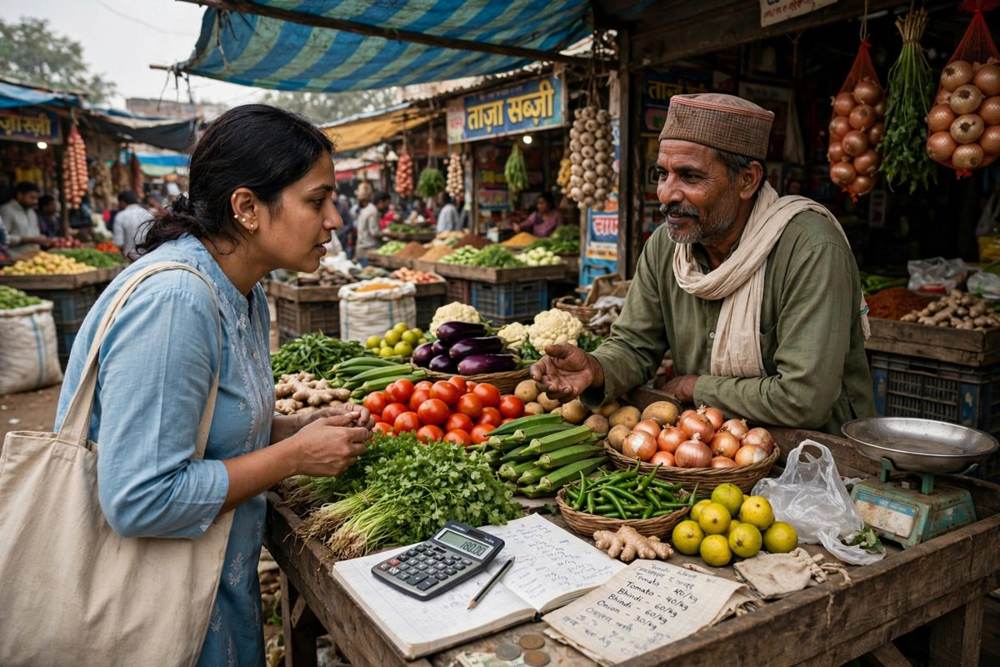
Stand at any vegetable stall in the morning. "Aloo, forty rupees a kilo." "Give me half a kilo." "Twenty rupees." This small exchange carries prices, weights and quick mental maths — all in a mix of languages. The day a student can do this fully in English, something changes. English stops being a subject and becomes a tool.
Teach the price words early: cost, price, total, change, bill, discount, free, offer. Teach the number words beyond twenty — thirty, forty, fifty, hundred, thousand — until they come without counting on fingers. These are not small words. These are survival words.
2. Dates, Time and the Calendar
"What is the date today?" sounds simple, but dates in English have their own music: "the fifth of November," "twenty twenty-six," "Monday, the seventeenth." Students hesitate here because nobody practises it aloud.
Make it a daily ritual. Every morning, one student announces the date in English. Every birthday in the family gets said in English. Exam dates, train times, festival days — say them, do not just read them. The tongue learns what the ear hears daily.
The same is true for time. "Quarter past four" and "half past six" are small phrases that make a speaker sound natural and confident.
3. Practise With Real Paper
Here is joyful homework: collect real paper. Old bills, bus tickets, shop receipts, a vegetable list, a school fee slip. Sit with your child or your class and read them aloud in English. "Milk — sixty rupees. Total — four hundred and twelve rupees. Date — the third of October."
It takes ten minutes. It costs nothing. And it connects English to the exact moments where life will demand it.
Fluency is not only about speaking beautifully. It is also about handling the small, money-and-number moments of the day without fear. Master these, and English becomes yours — not just in the classroom, but in the bazaar, the bank and beyond.