
Editorial
Say It in English: Festivals, Food and Your Own World
Your festivals, your food and your own world deserve English words too. Learn to describe the things closest to your heart, and the language becomes truly yours.
By Ananya Deshpande (R&D Team, Lingobotix) | November 2026
Ask a student to describe a birthday party and she speaks easily — cake, candles, balloons. Now ask her to describe Diwali in English. Silence. Not because she knows less about Diwali — she knows a hundred times more. But nobody ever gave her the English words for her own world.
This is a quiet gap in our English teaching. We teach the words for foreign things and forget the words for the things closest to the heart.
It happens innocently. Our textbooks come filled with pictures of snow, apples and red buses — fine things, but far away. Meanwhile the child's own street, her own kitchen, her own festivals wait outside the book, unnamed in English. No wonder she feels the language belongs to other people.
1. Your World Deserves Words
Every home is full of things that need English names: the diya and the rangoli, the prasad and the aarti, grandmother's special halwa, the new clothes, the bursting crackers, the rows of sweets. When a learner can describe these, English stops being a school subject. It becomes a language that can hold her whole life.
And this matters beyond the classroom. One day this student may guide a visitor, write an essay, speak at a function, or work in a hotel or office where a guest asks, "What is this festival?" On that day, the words for her own world will be her pride.
2. Build Your Festival Word Box
Here is a lovely activity for home and class. Before the next festival, make a word box together. Write the English words on small cards: lamp, flame, decorate, celebrate, blessings, sweets, fireworks, gathering, tradition, greet. Ten cards are enough.
Use each word in one true sentence. "We light diyas to welcome goodness." "My mother decorates the doorway with flowers." Sentences about your own home are remembered forever, because they are not from a book — they are from your life.
Do the same for food. Learn to say what is in the thali, how the dish is cooked, when it is eaten. "This is made of rice and jaggery. We eat it during the harvest festival." Food is the easiest topic in the world — everybody loves talking about it.
3. Be the Guide of Your Own Street
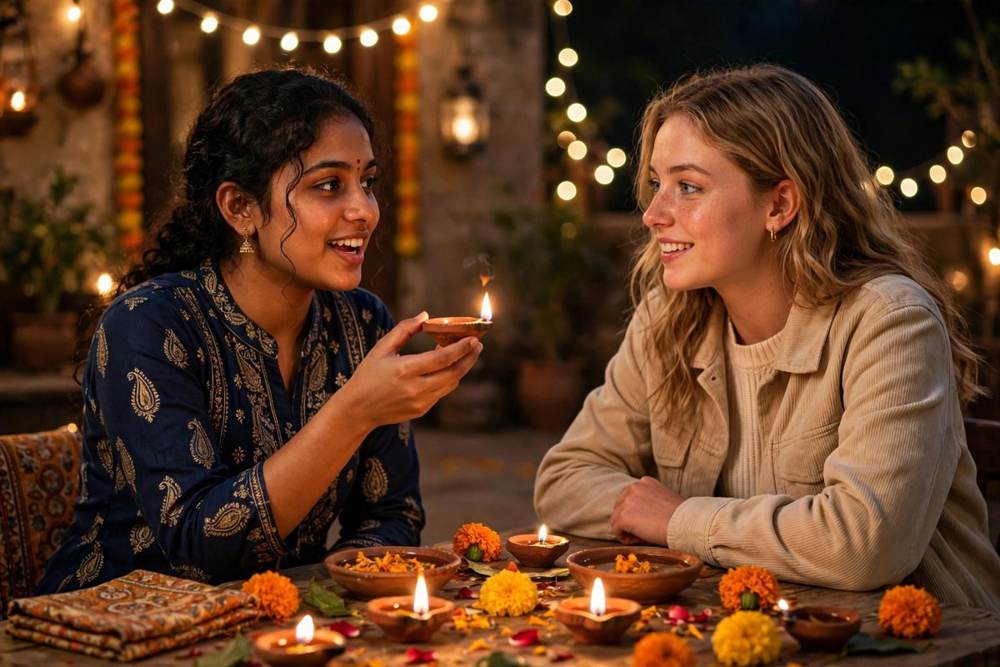
The final step is joyful: become a guide. When a friend, a visitor or even a cousin from another town comes, explain your festival, your food, your street in English. Walk and talk. "This is our temple. During the festival, the whole street glows."
You will search for words. You will gesture and laugh and find a way. That searching is not failure — it is the exact exercise that builds fluent speakers.
English came from far away, but it belongs to anyone who uses it. Use it for the things you love most. When your own world can live in English, the language is truly yours.