Editorial
Never Too Late: English After Forty
The door to English never closes. A warm word for adult learners on small daily steps, strong reasons and the quiet pride of beginning at any age.
By Priya Nair (R&D Team, Lingobotix) | November 2026
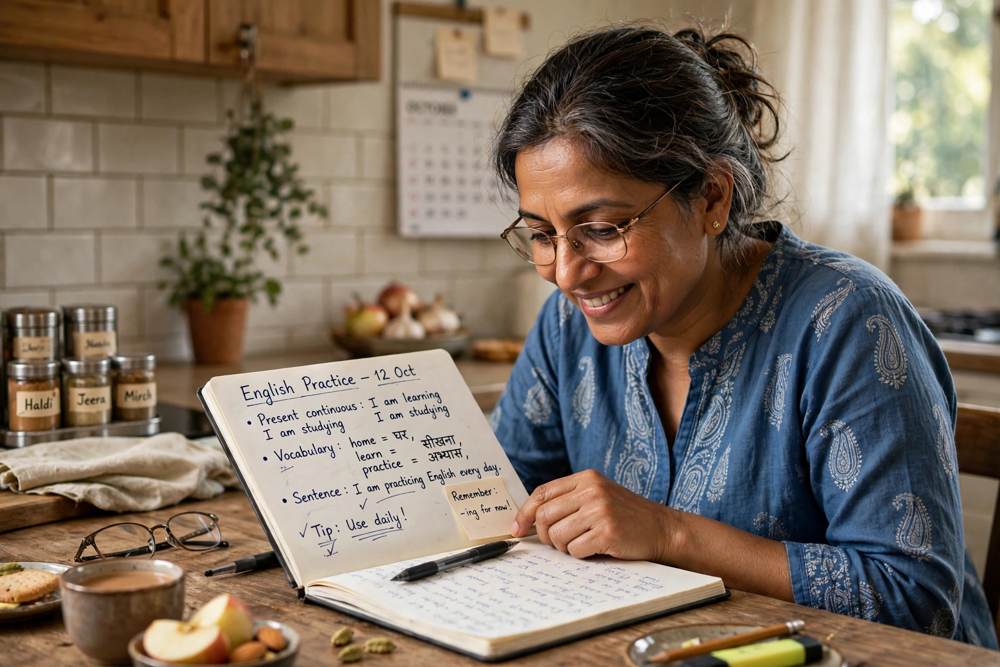
She is forty-six. She runs a home, manages a family business's accounts, and can bargain in the market like a champion. But when her daughter's school principal speaks to her in English, she smiles, nods — and says nothing. Later, at the kitchen table, she opens a notebook and writes, in careful letters: "Good morning. My name is Sunita." She is learning English. She is not late. She is right on time — her time.
1. The Myth of the Closing Door
We are told that languages must be caught young, like trains that leave the station once. This is only half true. Children learn pronunciation effortlessly, yes. But adults bring gifts that children do not have: discipline, patience, clear reasons, and a lifetime of understanding how the world works.
An adult knows why she is learning. She wants to speak to the doctor without fear, help her children with homework, grow her business, travel without depending on others. A strong reason is the best teacher in the world, and adults have the strongest reasons of all.
Research agrees: adults who practise regularly learn grammar and vocabulary as fast as the young — often faster. The door does not close at forty. It was never locked. It only needed someone to push it.
2. Small Steps, Every Single Day
The adult learner's enemy is not age. It is the busy day. So the method must fit the life, not fight it.
Twenty minutes is enough — twenty honest minutes. Learn five useful sentences a week, sentences from your own life: at the bank, at the clinic, at your child's school. Write them in a notebook that lives on the kitchen table, not hidden in a drawer. Speak them aloud while cooking. The kitchen has heard a thousand lessons in every subject; it can hold English too.
Use the phone in your hand. One English song while washing dishes. One short video while the tea boils. Speak to shopkeepers in English when you can, and forgive yourself the mistakes. At forty, we have survived far worse than a wrong verb.
3. Your Experience Is Your Strength
Do not compare yourself with the neighbour's child who speaks fluently. Compare yourself with yourself, three months ago. That is the only fair race, and you are winning it.
Remember, too, that you are not starting from zero. You already understand English everywhere — on signboards, in films, in your children's books. You are not filling an empty vessel. You are waking a language that has been quietly listening for years.
And when your daughter corrects your pronunciation, smile and let her. The day a mother learns from her child, and the child teaches with pride, English has done something beautiful in that home.
It is never too late to learn a language. It is only too late to believe that you cannot. Open the notebook. The first sentence is waiting, and so is the woman you are about to become.