
Editorial
The Red Pen Is a Friend
Those red marks in your notebook are signposts, not punishments. How to read corrections without fear, rewrite them well and let them polish your English.
By Rohan Mehta (R&D Team, Lingobotix) | November 2026
Ask students what frightens them most in English class, and many will not name the examination. They will name the red pen. That bright, angry-looking line under a word. The cross in the margin. The notebook that comes back looking, as one boy said, "like it has been in a fight."
But the red pen is not the enemy of the student. Used well, it is one of the truest friends a learner has — and it is time we made peace with it.
1. A Correction Is a Signpost, Not a Punishment
Imagine travelling to a new city without signboards. You would walk in circles for hours, arriving nowhere, blaming your feet. A teacher's correction is a signboard. It does not say, "You are bad." It says, "The road turns here."
Every red mark is proof of something hopeful: a teacher read your work carefully enough to stop at your exact mistake. Nobody corrects an empty page. The red ink exists because the writing exists — because you attempted, in a new language, to say something real.
Students who fear correction begin to write less, and write safely — tiny sentences, known words, no risks. Their notebooks look clean, but their English stops growing. A page full of red and full of courage will always beat a clean page full of nothing.
2. Read the Red, Then Rewrite
A correction only helps when it is used. So here is a simple ritual for every returned notebook.
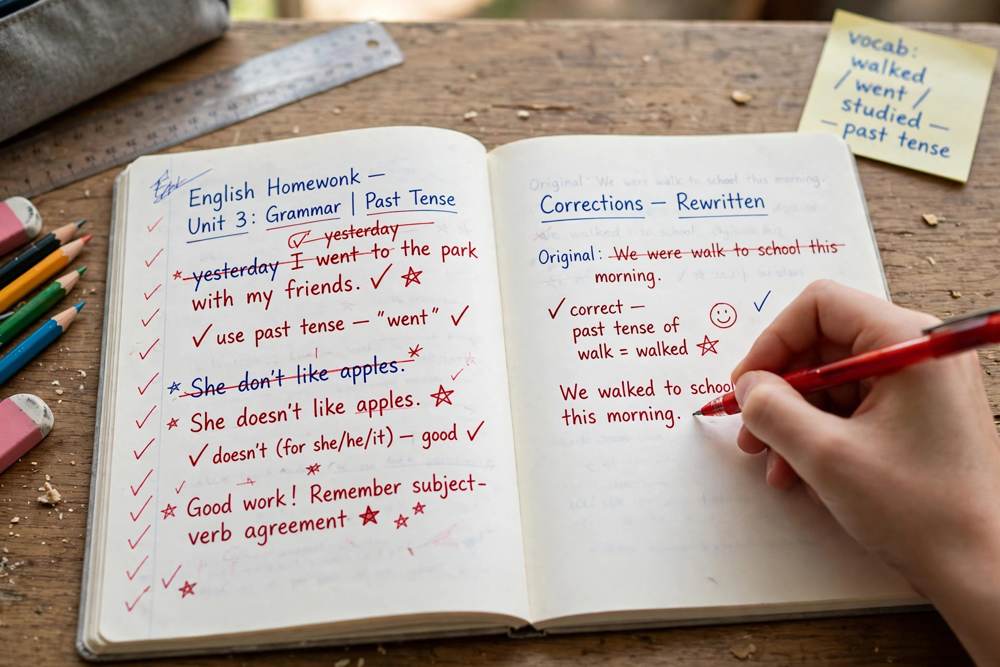
First, read every mark slowly — not with shame, but with curiosity, like a detective reading clues. Ask: what was I trying to say, and what does the correction teach me? If a mark is not understood, ask the teacher. Good teachers are delighted by that question; it is the sound of learning happening.
Then, rewrite the corrected sentence once, neatly, below the original. This single act — hand moving, eye watching, mind agreeing — moves the correction from the teacher's pen into your own memory. Keep a small "my mistakes" page at the back of the notebook. Patterns will appear. Perhaps the articles escape you, or the past tense slips. Once you can see your pattern, you can defeat it.
3. Ticks and Stars Matter Too
Notice, finally, what students often miss: the red pen also writes the good things. The tick beside a fine sentence. The star. The "Good!" in the margin. Teachers mark what is right as faithfully as what is wrong — we simply forget to celebrate the ticks because the crosses shout louder.
So count the ticks. Let them encourage you. And thank the hand that holds the pen, whether it belongs to a teacher, a parent, or a friend checking your work.
The red pen is not judging your worth. It is polishing your words, the way a cloth polishes brass — with friction, yes, but always towards shine. Open your notebook without fear. Your friend has been writing in it, in red, all along.