
Editorial
A Hundred Days of English
Twenty honest minutes a day for a hundred days can change your English and your confidence. Make your streak visible, protect the chain and watch yourself grow.
By Ananya Deshpande (R&D Team, Lingobotix) | November 2026
Nobody climbs a mountain in one heroic jump. They climb it in ordinary steps, taken daily, until one morning the view changes. English works exactly the same way — and that is why we ask you to consider a small, brave promise: one hundred days of English. Not a hundred perfect days. A hundred honest ones.
1. Why a Hundred Days Works
A hundred days is long enough to change a life and short enough to imagine. In a hundred days of daily practice — even twenty minutes a day — a learner meets thousands of sentences, hundreds of new words, and one priceless discovery: "I am a person who does not give up."
Big, irregular efforts fail us. The student who studies five hours on Sunday and nothing all week forgets most of it by Wednesday. Memory is built by return visits. Twenty minutes every day beats five hours once a week, every single time, because the brain keeps what it meets often.
The hundred days also end the daily debate. There is no deciding "Shall I study today?" The answer was given on day one. What remains is only the pleasant question: "What shall today's English be?"
2. Make the Streak Visible
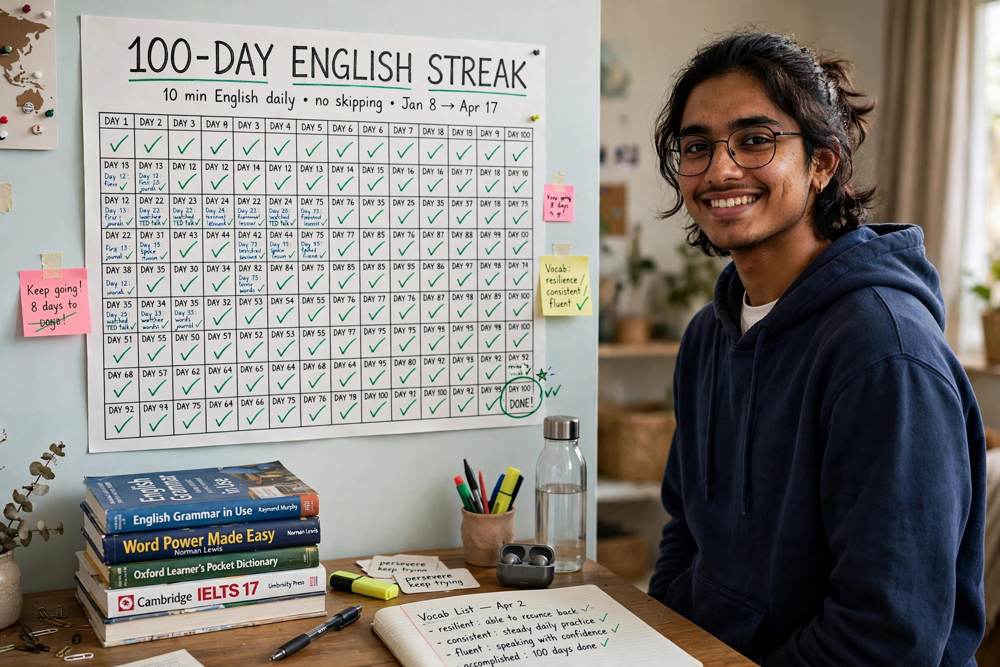
Take a chart — a calendar, a notebook page, a handmade poster on the wall — and mark every day you practise with a proud tick. This sounds childish. It is, in fact, how champions in every field protect their habits.
The growing line of ticks becomes precious. By day thirty, you will practise on a tired evening not for English alone, but to protect the chain. By day sixty, the chart is a story you are telling about yourself, and you will not want the story to break.
Keep the daily task small and varied so the chain survives busy days: one page read aloud, ten new words, one English conversation, one song understood, one short paragraph written. On the hardest days, five honest minutes still earn the tick. The rule is not "study much." The rule is "never miss."
3. The Person at Day Hundred
Something quiet happens around day seventy. Sentences that once needed translation begin to arrive directly in English. The newsreader slows down — or rather, you speed up. A stranger speaks to you in English, and you answer before fear can interrupt.
On day one hundred, mark the final tick and celebrate properly. You will not be a perfect English speaker; nobody is, in any language. But you will be something rarer and more valuable: a proven learner, with a chart on the wall that testifies in your own handwriting.
Then, of course, you will do what every finisher does. You will smile, turn the page — and begin the next hundred days.
Mountains are climbed in ordinary steps. Take the first one today, and put a tick where the whole house can see it.